
The short answer
A garage door spring under tension can store the energy equivalent of several sticks of dynamite in miniature form. When it's released suddenly, by a slipped winding bar, a worn cable, or a hand in the wrong place, that energy doesn't care whether you've watched a tutorial. It snaps a bar into your face, slices a finger to the bone, or whips a 200-pound door down on top of you. This is why emergency rooms across the country see the same injury pattern every year: broken fingers, fractured facial bones, deep lacerations, and crushed hands, almost all from homeowners attempting spring work without the right tools or training.
What actually goes wrong
Garage door springs come in two types, and both are dangerous in different ways.
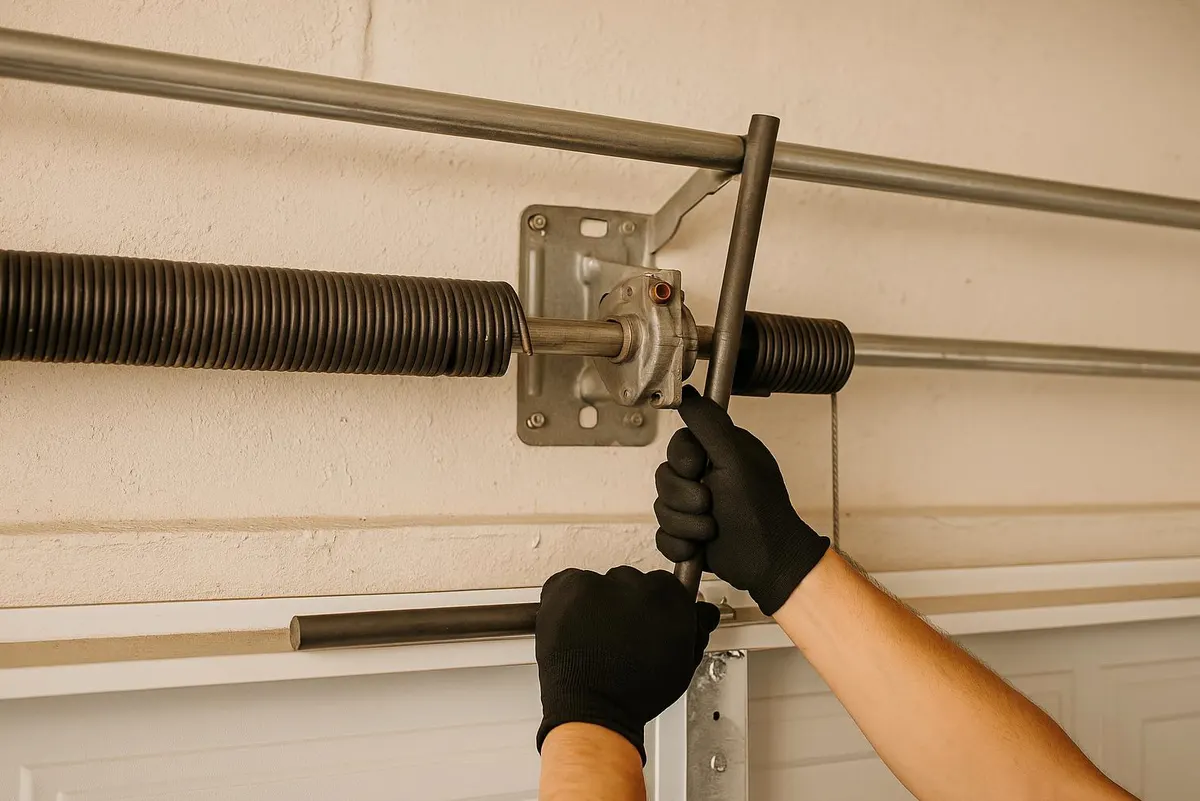
- Torsion springs sit above the door on a metal shaft and twist to create lifting force. Winding or unwinding them requires steel winding bars inserted into cone-shaped fittings. If a bar slips out, or if someone uses a screwdriver instead of the correct bar, the spring can unwind violently in a fraction of a second.
- Extension springs stretch along the horizontal tracks above the door. Without safety cables running through them, a broken or disconnected extension spring becomes a metal projectile capable of crossing a garage at high speed.
In both cases, the failure point is almost never the spring itself failing gracefully. It's the moment someone tries to control that stored energy with the wrong tools, insufficient leverage, or no idea how many turns the spring actually needs.
Why humidity makes this worse here
In this part of Alabama, heat and humidity take a toll on metal components over time. Moisture works into the coil gaps and mounting hardware, causing surface rust that weakens the spring unevenly. A rusted spring doesn't fail predictably. It can hold tension right up until the moment it doesn't, then let go without warning. After a stretch of afternoon downpours or a storm system moving through, it's worth a visual check for rust streaks or pitting on the spring coils, but that check should be look-only, not hands-on.
How badly people get hurt
The injuries aren't minor. A winding bar released under tension moves fast enough to break bones on impact. Fingers get caught in the coils as a spring unwinds. Eyes are at risk from flying metal fragments if a spring snaps mid-adjustment. Backs and shoulders get strained or worse when a door drops unexpectedly because a spring was disconnected before the door was properly secured. None of these are freak accidents. They're the predictable result of hand tools and body parts being in the path of stored mechanical energy.
What actually prevents it
If you take nothing else from this, take these:
- Never work on a torsion spring without the correct winding bars, sized to the cone, and never substitute screwdrivers, pliers, or anything improvised.
- Secure the door before touching anything, using locking pliers on the track so the door can't shift or drop while the spring is disconnected.
- Keep your body out of the spring's plane of motion at all times, including your face, since a failure sends force outward along the shaft.
- Check for rust and wear visually, not by hand, especially after humid stretches or storm season, and treat visible corrosion as a sign the spring needs replacement, not adjustment.
- Replace both springs as a pair if your door uses two, since one old and one new spring creates uneven tension that stresses the whole system.
If you're reading this because a spring already looks stretched, rusted, or has a visible gap in a coil, stop there. That's not a repair to finish yourself, even partway.
When to call McCalla Garage Door Pro
If you've noticed a sagging door, a loud bang followed by a door that won't lift, or visible rust and gaps on the spring coils, that's our cue, not yours. Our Spring Repair & Replacement service uses the correct winding tools, matched spring sets, and proper door securing procedures every time, and we check the rest of the hardware while we're there. If the spring has already failed and the door is stuck, our Emergency Garage Door Service gets a technician out fast so the door isn't left unsecured overnight.
Call McCalla Garage Door Pro for a safe, same-visit spring repair or replacement anywhere in McCalla, AL and the surrounding area. It's a job worth leaving to someone with the right bars, the right technique, and the experience to know when a spring is one bad afternoon away from letting go.